Science vs Arts Result 2026: What to Compare First
Compare the two on the same footing first: total marks out of 1100 and the percentage. Punjab boards mark the Science group and the Arts (Humanities) group on an identical 1100-mark scale, with the same A+ to F grading. A 78% in Arts and a 78% in Science are the same grade and the same division. Only after that should you read subject-by-subject and weigh what each student plans to study next.
Both groups sit on the same 1100 scale
Under the Punjab boards (BISE), matric totals 550 marks in 9th plus 550 in 10th — 1100 for every student, Science or Arts. First division starts at 660 marks (60%). The grade bands match too: A+ is 90% and above, A is 80–89%, B is 70–79%, and downward from there. So the honest headline comparison is percentage against percentage, never “science marks versus arts marks.”
Read also: After Matric Result: FSC, ICS, ICom or DAE?
What to compare first, in order
1. Total percentage and division
Start here. It is the one number that means the same thing across both groups. Turn marks into a percentage, note the division, and you have a fair like-for-like read.
2. The overall grade
The letter grade follows the same cut-offs for both groups. An A in Arts and an A in Science reached the same band — the grade already normalises the difference.
3. Subject-wise marks and practicals
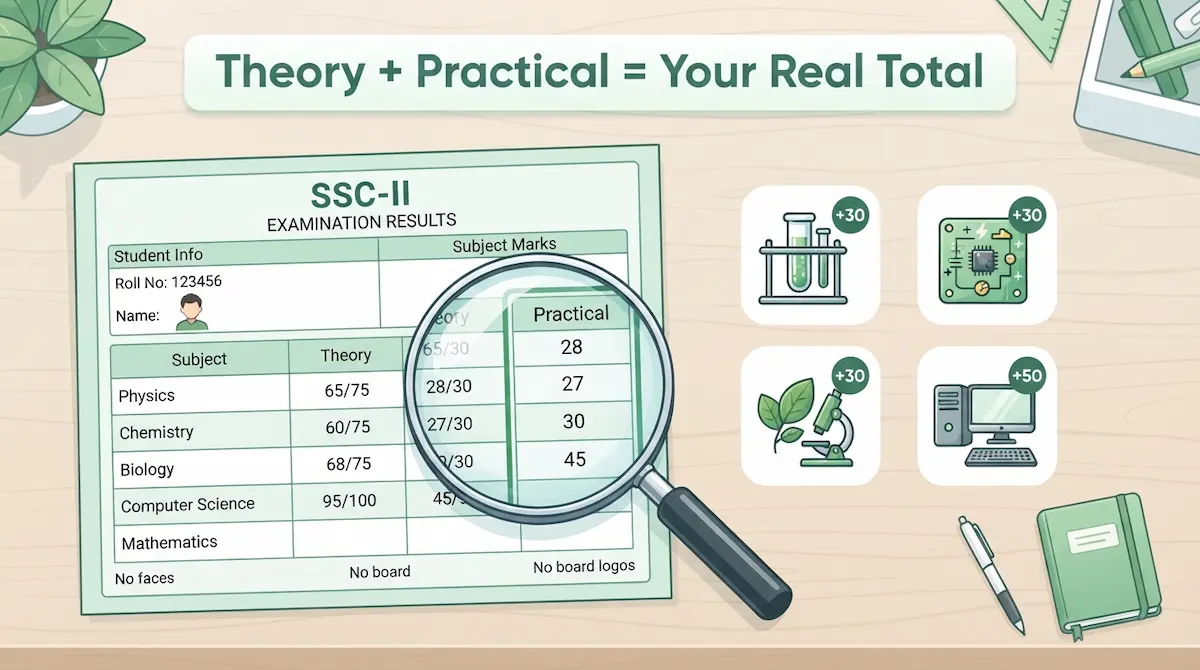
This is where the groups split. Science electives — Physics, Chemistry, and Biology or Computer Science — carry practical components (around 30 marks per subject), which Arts electives do not. So check where marks were won or lost: a science student can lift their total through practicals, while an arts student’s score rests almost entirely on written papers. The subject breakdown tells you more than the final figure alone.
The 2026 rule that changes the comparison
For years, the group chosen in 9th class decided a student’s options after matric. That barrier is gone for this cohort. In its 183rd meeting, the IBCC notified (12 December 2025) that Arts-group students can now register for FSc Pre-Medical, FSc Pre-Engineering, ICS, and I.Com at intermediate level, effective from the SSC 2026 exams, subject to seat availability. An Arts result no longer locks a student out of science streams — so compare the two on merit and interest, not on which group “allows more.”
One caveat: entry tests like MDCAT and ECAT still require the actual FSc science subjects. Moving from Arts into FSc Pre-Medical still means studying Biology, Chemistry, and Physics in college. The door is open; the science work still has to be done.
Read also: Matric Result 2026: Every Board’s Date in One List
Does a higher number mean the better result?
Not on its own. Since both groups share one scale and one grading system, a percentage is a percentage — there is no “arts bonus” or “science penalty.” What separates two strong results is direction. The Science group fits pre-medical, pre-engineering, and technical fields; the Arts group fits law, media, education, CSS preparation, and social sciences. Match the result to the goal, not to which group sounds harder.
FAQ
Are Science and Arts marked out of the same total?
Yes. Both are out of 1100 under Punjab boards, with identical A+ to F grading and the same 660-mark first division.
Can an Arts student take FSc after matric in 2026?
Yes. After the IBCC’s December 2025 notification, Arts-group students can enrol in FSc Pre-Medical, Pre-Engineering, ICS, or I.Com from the 2026 exams, where seats allow.
Which group scores higher?
Neither by rule. Marks depend on the student, not the group — the scale is the same for both.