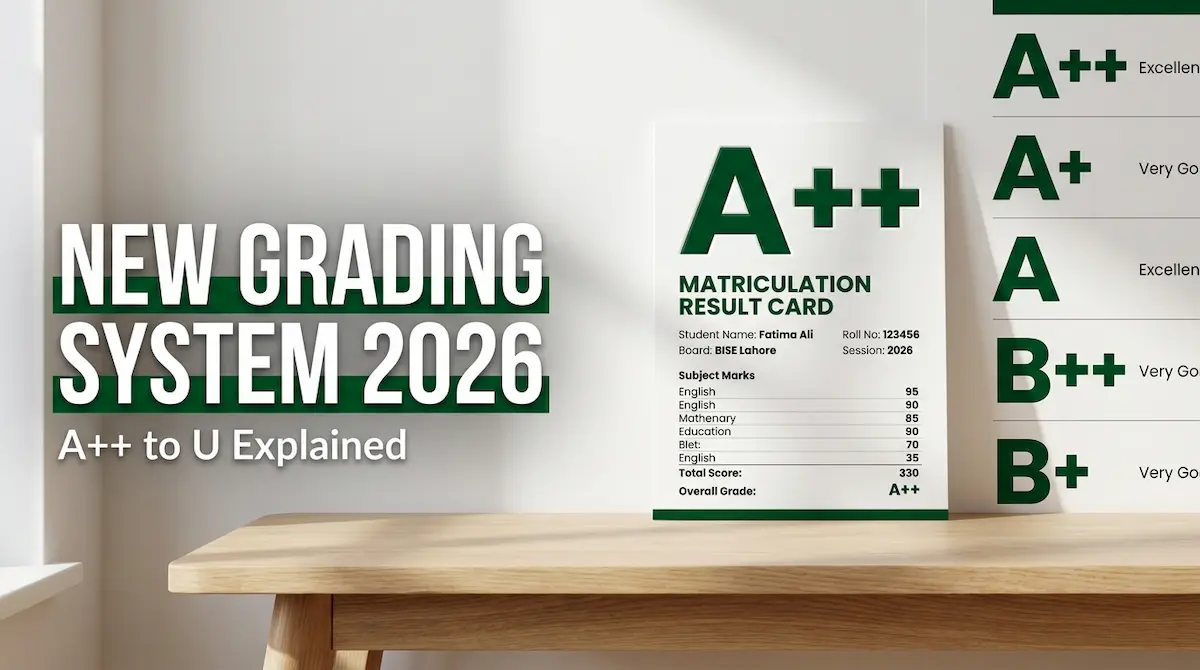
New Matric Grading System 2026: A++ to U Explained
The Inter Board Coordination Commission (IBCC) has replaced the traditional 7-point marking system with a 10-point grade scale for matric and intermediate exams starting 2026. The new system uses letter grades from A++ (Extraordinary) down to U (Ungraded), raises the passing threshold from 33% to 40%, and removes the words “Fail” and “Pass” from result cards.
For the 2026 annual exams, the new policy applies to 9th class (SSC-I) and 11th class (HSSC-I) only. The 10th class (SSC-II) will continue under the old marks system in 2026 and switch to the new grading from 2027.
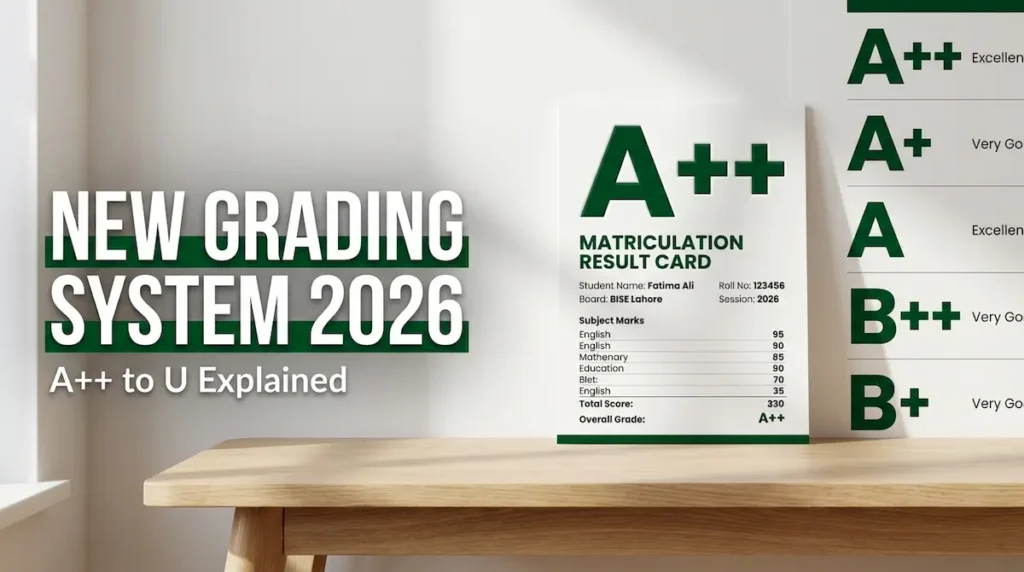
The Complete A++ to U Grade Chart
| Grade | Marks Range | Description |
|---|---|---|
| A++ | 96% – 100% | Extraordinary |
| A+ | 91% – 95% | Exceptional |
| A | 86% – 90% | Outstanding |
| B++ | 81% – 85% | Excellent |
| B+ | 76% – 80% | Very Good |
| B | 71% – 75% | Good |
| C+ | 61% – 70% | Fair Good |
| C | 51% – 60% | Above Average |
| D | 40% – 50% | Emerging |
| U | Below 40% | Ungraded |
This structure is modeled on the Cambridge International Examinations assessment approach, where high-performing students are separated into finer categories instead of one broad A grade.
Why the Grading System Changed
The old A-1 grade lumped together everyone scoring between 80% and 100%. A student with 81% and a student with 99% received the same grade on their certificate. Universities, scholarship committees, and foreign institutions had no way to distinguish between them without checking raw marks.
The new system fixes this by splitting the top tier into A++, A+, A, and B++, giving exceptional performers visible recognition.
Key reasons behind the reform
- Align Pakistani matric and intermediate certificates with international standards followed by Cambridge, IB, and Edexcel
- Reduce unhealthy competition for marks like 99 vs 98
- Discourage rote learning and grade inflation
- Prepare the system for a future GPA and CGPA framework, expected by 2029
What Changes on the Result Card
Beginning with the 2026 annual exams, board result cards for 9th and 11th class students will display:
- Subject-wise letter grades (A++ to U) instead of just marks
- Absolute scores alongside grades during the transition period
- No traditional position holders in some provinces, since the gap between top grades is now visible through letters
- The word “Ungraded” (U) replaces “Fail” for students scoring below 40%
A student earning a U grade is permitted to reappear in the supplementary or next annual examination, subject to board rules.
The 40% Passing Marks Rule
Under the previous system, students needed 33% per subject to pass. The new IBCC policy raises this minimum to 40% per subject. Anything below 40% is now classified as U (Ungraded).
This is the single biggest change for borderline students. Around 7% of matric candidates historically scored between 33% and 39%, a range that now falls outside the passing band.
Implementation Timeline Across Boards
The rollout is phased to give students, teachers, and admission systems time to adjust.
2026 (First Annual Exams)
- New grading applies to SSC-I (9th class) and HSSC-I (11th class)
- 10th and 12th classes continue with the old marks system
2027 (First Annual Exams)
- New grading extends to SSC-II (10th class) and HSSC-II (12th class)
- All matric and intermediate students now on the same grade scale
2029 (Tentative)
- Universities expected to transition to CGPA-based admissions
- Raw marks may no longer appear on official mark sheets
Which Boards Have Adopted the New System
The policy applies to all examination boards in Pakistan except foreign boards operating in the country. Confirmed adopters include:
- Federal Board (FBISE) – Islamabad
- All Sindh boards (Karachi, Hyderabad, Sukkur, Mirpurkhas, Larkana)
- Balochistan Board (BBISE) – Quetta
- Azad Jammu and Kashmir Board
- Gilgit-Baltistan Board
- All Punjab boards (Lahore, Gujranwala, Rawalpindi, Multan, Faisalabad, Sargodha, Sahiwal, Bahawalpur, DG Khan)
- All KP boards (Peshawar, Mardan, Swat, Abbottabad, Bannu, DI Khan, Kohat, Malakand)
Read also Matric Result 2026 Date Confirmed: August 6 Countdown
Impact on University Admissions
For the 2026–2027 admission cycle, universities can continue accepting raw marks or use the new grades. After all boards complete the transition by 2029, admissions will rely entirely on grades and eventually CGPA.
The policy has been formally communicated to:
- Higher Education Commission (HEC)
- Pakistan Engineering Council (PEC)
- Pakistan Medical and Dental Council (PMDC)