After Matric Result: FSC, ICS, ICom or DAE?
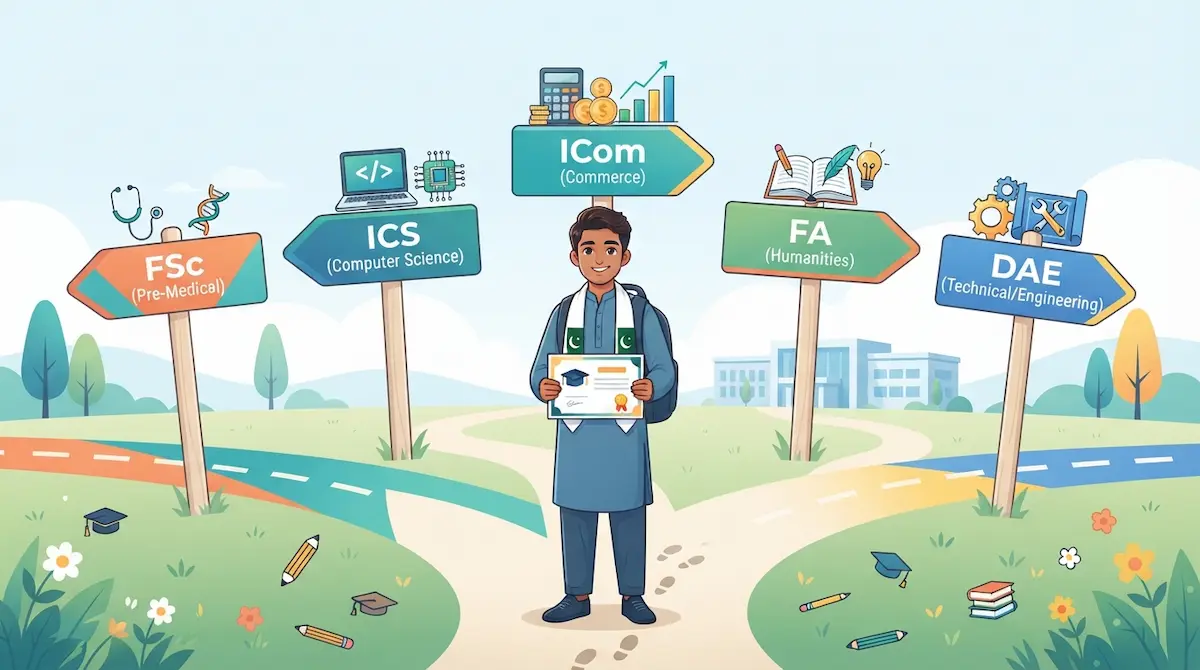
Your matric result sets your baseline, but the group you choose now shapes your degree, your entry test, and your career for years. Here’s how each intermediate track works and who it suits.

FSc: The science route to medicine and engineering
FSc (Faculty of Science) splits into two groups.
FSc Pre-Medical
Subjects: Biology, Chemistry, Physics. This is the path to MBBS, BDS, Pharm-D, DPT, and nursing, all gated by the MDCAT entry test. Choose it if biology genuinely interests you and you’re ready for tough competition.
FSc Pre-Engineering
Subjects: Mathematics, Chemistry, Physics. It feeds into engineering (civil, electrical, mechanical), architecture, and physical sciences through the ECAT and university admission tests.
Pick FSc if you want a professional field and can handle a heavy science load.
ICS: For computing and IT careers
ICS (Intermediate in Computer Science) usually combines Computer Science, Mathematics, and Physics; some boards allow Statistics in place of Physics. It leads to BS Computer Science, Software Engineering, IT, artificial intelligence, and data science. If you enjoy coding, logic, and problem-solving—and want a growing job market—ICS is the strongest fit.
ICom: The commerce and finance path
ICom (Intermediate in Commerce) covers accounting, business, economics, and business mathematics. It’s the natural lead-in to B.Com, BBA, ACCA, CA, and roles in banking and finance. Choose it if you’re comfortable with numbers, money, and business thinking rather than lab sciences.
FA: Flexible humanities and social sciences
FA (Faculty of Arts) offers flexible subject combinations—psychology, sociology, education, journalism, fine arts, and languages. It opens BA, LLB (law), mass communication, teaching (B.Ed), and later CSS/PMS. FA suits students drawn to writing, society, media, or public service. It’s a serious academic route, not a fallback.
DAE: Job-ready technical skills
DAE (Diploma of Associate Engineering) is a three-year technical diploma from boards like PBTE, unlike the two-year FSc, ICS, ICom, and FA programs. Fields include civil, electrical, mechanical, electronics, and computer information technology. IBCC treats DAE as equivalent to intermediate, so you can move on to a B.Tech or BE, or start working as a skilled technician right after. Choose DAE if you prefer hands-on skills and faster employability over a purely academic track.
How to choose the right group
Match your decision to three things:
- Interest: the subjects you’ll study daily for the next two to three years.
- Career goal: the degree and profession each track leads to.
- Entry test: MDCAT for medical fields, ECAT or university tests for engineering, and usually none for commerce and arts programs.
Don’t pick a group only because of family pressure or what your friends chose. A strong result in a group that fits you beats an average result in one that doesn’t.
Check your Matric Merit by our Matric Merit Calculator.
Quick comparison
- Doctor or pharmacist: FSc Pre-Medical
- Engineer or architect: FSc Pre-Engineering
- Software or IT: ICS
- Business, finance, accounting: ICom
- Law, media, teaching, civil service: FA
- Skilled technician or fast job entry: DAE
Your marks decide eligibility; your interest decides success. Choose the track you can commit to fully, then start preparing for the relevant entry test early.